Lost security deposit checks, manual refunds, guests who leave before the property inspection: handling security deposits remains a hassle for campgrounds, hotels, and rental companies. The bank imprint on the point-of-sale terminal—known as PLBS in the CB network—solves the problem. The amount is reserved on the guest’s card without being charged, then released or cashed out at the end of the stay.
In this article: the difference between a security deposit, a credit card imprint, and PLBS; the credit card rules you need to know (including the 30-day limit); and how our clients in the outdoor lodging, hotel, and rental industries use them on a daily basis.
Security deposit, bank imprint, pre-authorization, PLBS: What are these terms?
These four terms refer to almost the same thing, viewed from different perspectives.
- The security deposit (or guarantee deposit) is the amount that ensures the rental proceeds smoothly: damage, cleaning, missing items, and additional charges. It is a contractual provision outlined in your Terms and Conditions.
- Pre-authorization is a banking transaction in which the merchant asks the customer's bank to reserve a certain amount on the customer's card. The funds are held, not transferred.
- A "bank hold " is the common term for this pre-authorization when it serves as a security deposit.
- The PLBS is the official framework of the CB network for this use case: “Local Payments for the Rental of Goods and Services.” There is also a “remote” version for collecting a security deposit without the customer being present.
In practical terms, when a campground guest hands you their card upon arrival, you place a PLBS pre-authorization, which serves as a pre-authorization hold to guarantee the security deposit specified in your Terms and Conditions.
Check, refundable debit card, or PLBS: Which security deposit method should you choose?
PLBS is the only method that does not withdraw any money from the customer's account and does not require the merchant to issue any refunds.
How do I process a deposit via direct debit on a point-of-sale terminal?
On the Easytransac POS terminal, the PLBS cycle consists of three steps, plus an optional fourth step.
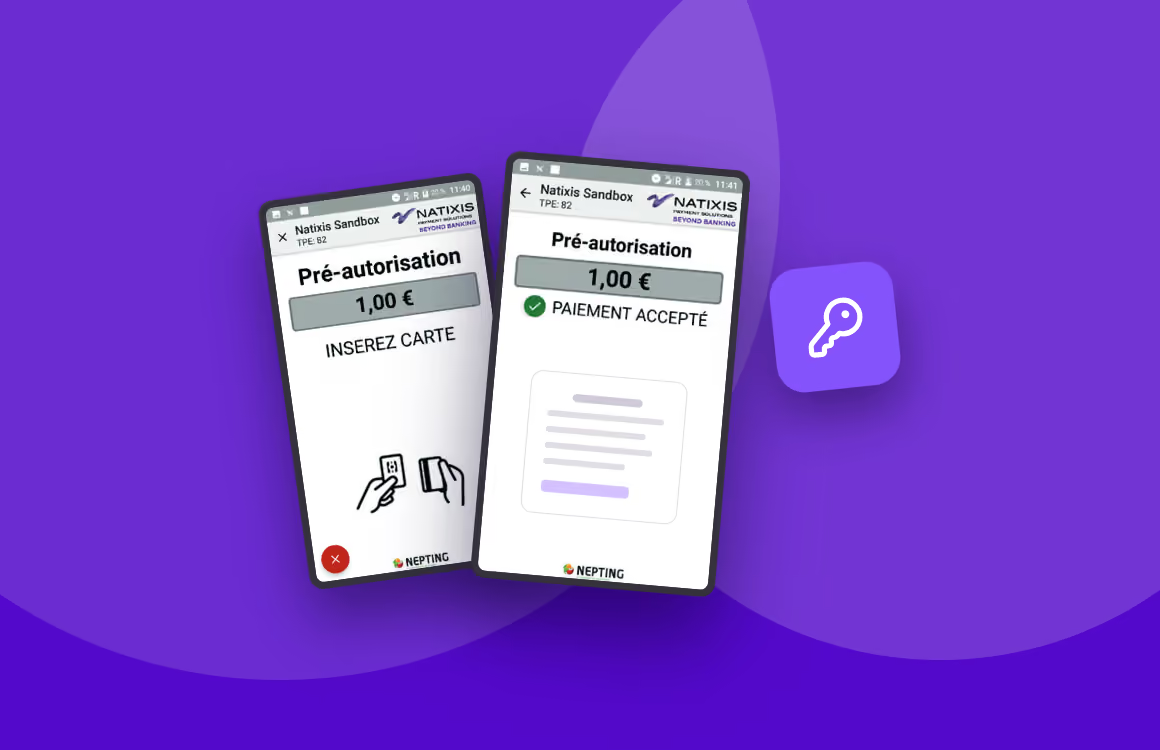
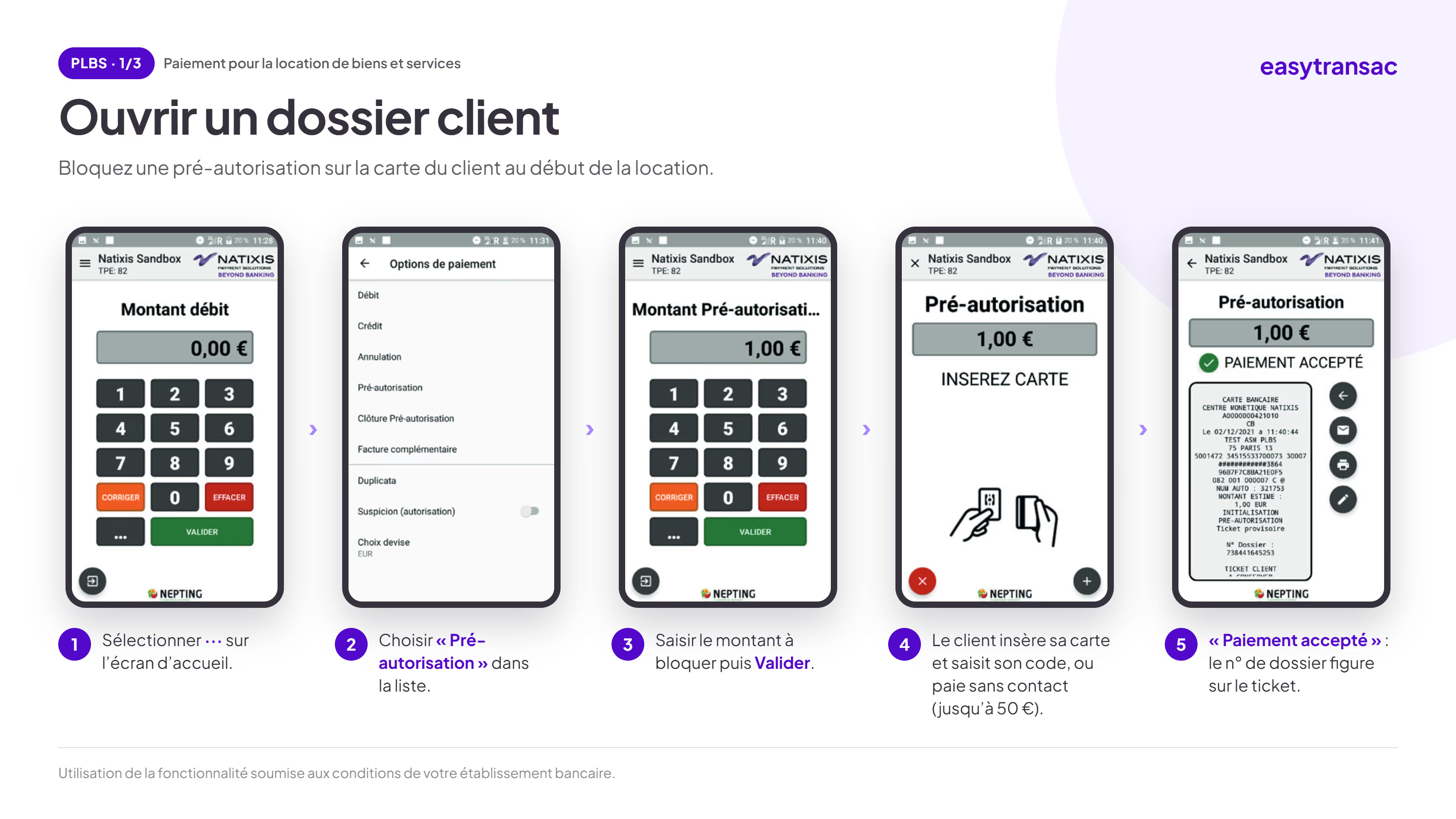
- Open the case upon arrival. On the payment terminal, open the “…” menu and select “Pre-authorization.” Enter the deposit amount specified in your Terms and Conditions and confirm. The customer inserts their card and enters their PIN, or pays via contactless for amounts up to €50. The screen displays “Payment Accepted” and the receipt shows the case number.
- During the stay or rental. The amount remains on hold in the customer's account. Nothing has been charged yet.
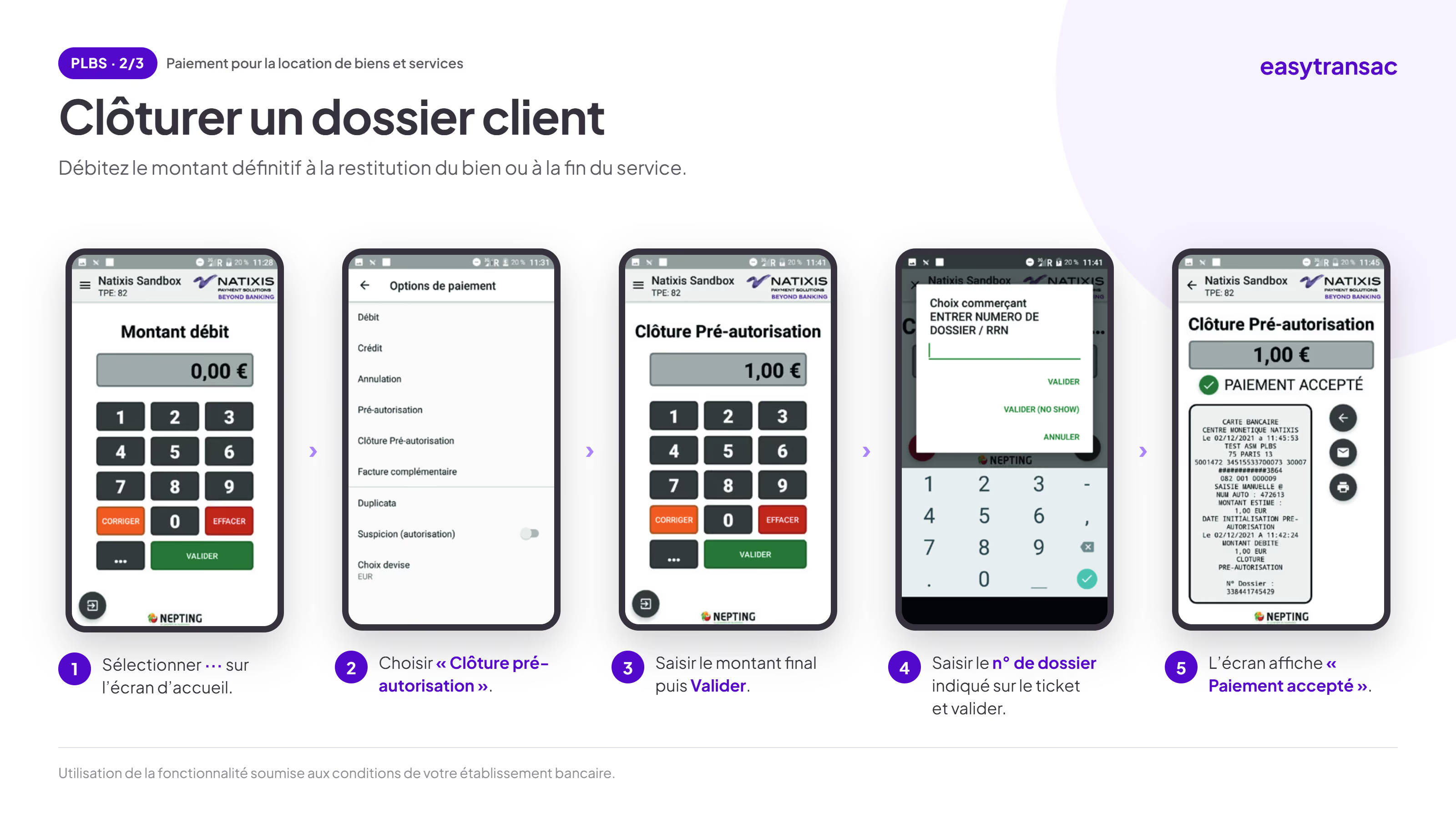
- Check out at the front desk without the card. From the “…” menu, select “Pre-authorization Checkout.” Enter the final amount to be charged (housekeeping, breakage, minibar), then enter the case number listed on the receipt. The guest does not need to be present.
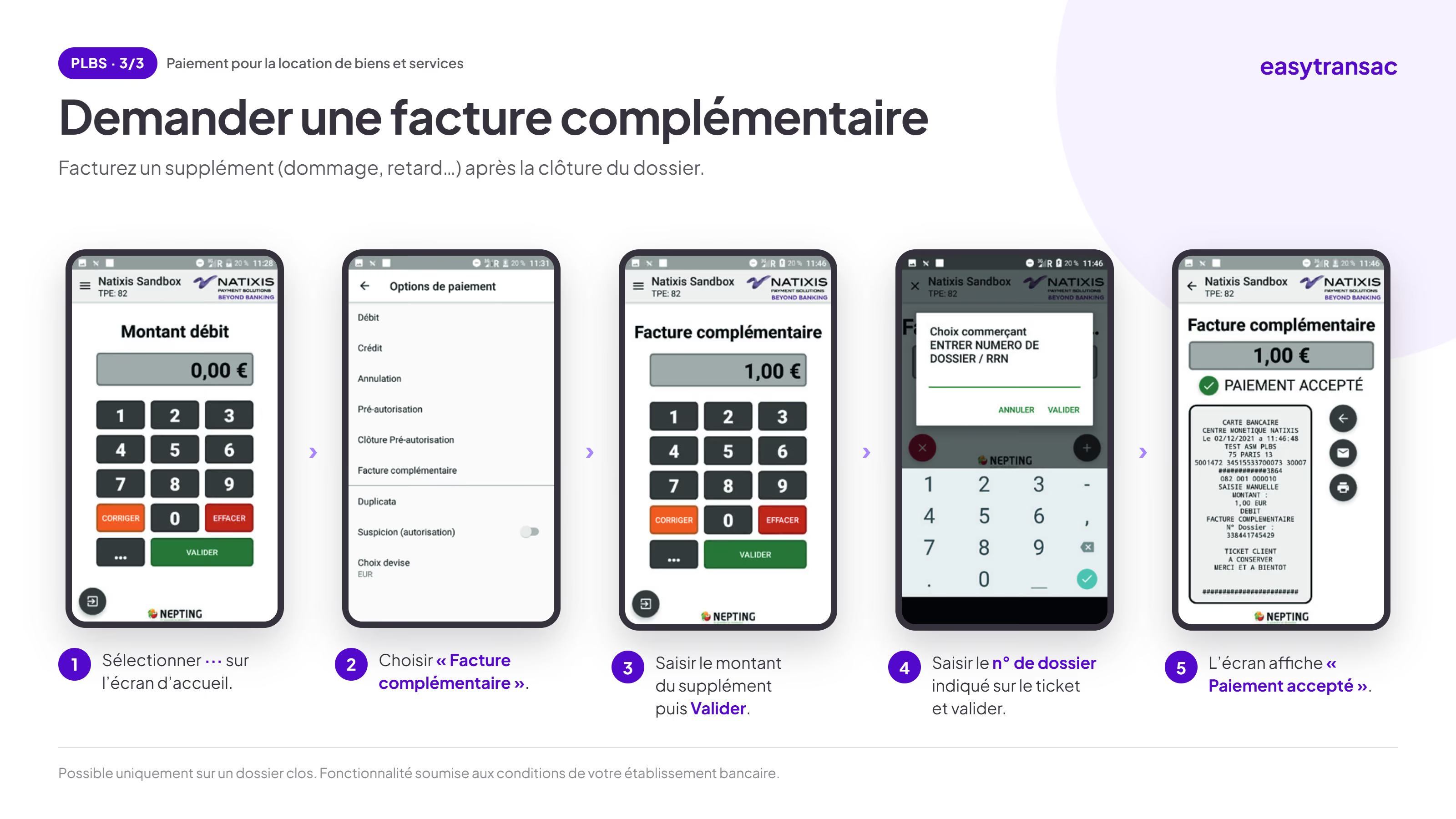
- Additional Invoice, if needed. Was damage discovered after the case was closed? The “Additional Invoice” menu allows you to charge an additional amount to a case that has already been closed, using the same case number.
Since the system can be closed without the card, early morning check-outs—before the front desk opens—are no longer a problem. [Screenshots of the POS system: opening, closing, receipt]
CB Rules to Follow for an PLBS Security Deposit
The PLBS is governed by the terms and conditions of the CB network, as set forth in the banks’ acceptance agreements. Four points are important in day-to-day operations.
- A maximum of 30 calendar days. The service must be completed no later than 30 days after the initial authorization. After this period, the authorization expires and you can no longer accept payments.
- For rental purposes only. The PLBS is used exclusively for the rental of goods or services: lodging, vehicles, and equipment.
- A consistent amount. You set the authorization based on the estimated amount of actual expenses, and you cannot collect more than the authorized amount.
- Not all cards are accepted. Cards that require systematic authorization—often entry-level debit cards—may decline the pre-authorization. Be sure to include an alternative in your Terms and Conditions.
Regarding transparency, the amount, duration, and terms of the deposit must be included in your terms and conditions of sale, which must be provided before the reservation is made.
Sources: PLBS In-Person Terms and Conditions (example of a bank amendment) · PLBS Remote Terms and Conditions
They use the banking fingerprint feature with Easytransac
From camping chains to ski rental shops, these customers use the bank card processing feature on the Easytransac point-of-sale terminal.
Camping: Say Goodbye to Security Deposits by Check
In the outdoor lodging industry, the security deposit covers rental accommodations (mobile homes, cabins) and often cleaning fees, with typical amounts ranging from €150 to €400. Checks remain a common method of payment, despite their limitations: lost checks, the need to mail them back after an early departure, and the risk of nonpayment in the event of a dispute.
Sandaya Group, 4- and 5-star outdoor accommodations. With a network of campgrounds in France and Europe, the security deposit must follow the same process at every location: authorization upon arrival via the payment terminal, and release after the property inspection.
Pausado Group, family-friendly campgrounds. A family-owned group with roots in Provence, operating both by the sea and in the countryside. The digital signature replaces the security deposit check and simplifies check-out before the front desk opens.
Hotels: Covering Extra Charges and Damage
At the hotel, the charge covers the minibar, drinks from the bar or restaurant charged to the room, and any damage. At check-out, the final bill is charged to the account opened upon arrival.
Ski rentals: equipment guaranteed without tying up the customer's money
A pair of high-end skis or an electric mountain bike is worth much more than a few days’ rental. In stores, the rush is concentrated on Saturdays during school breaks: customers need to get their gear quickly, without any paperwork. The deposit taken at the counter covers damage or loss, and is refunded when the equipment is returned.
Evasion Sport, a sporting goods store and ski rental shop. The same point-of-sale system is used for in-store sales and for processing security deposits on equipment rentals.
The PLBS Security Deposit with Easytransac
With Easytransac, you can manage security deposits on the same terminal you use for your daily transactions. No need to rent additional equipment.
- A receipt is printed on the point-of-sale terminal when the customer arrives, and the transaction is closed upon departure using only the case number
- Partial collection of actual expenses: At the end of the period, you enter the amount to be debited
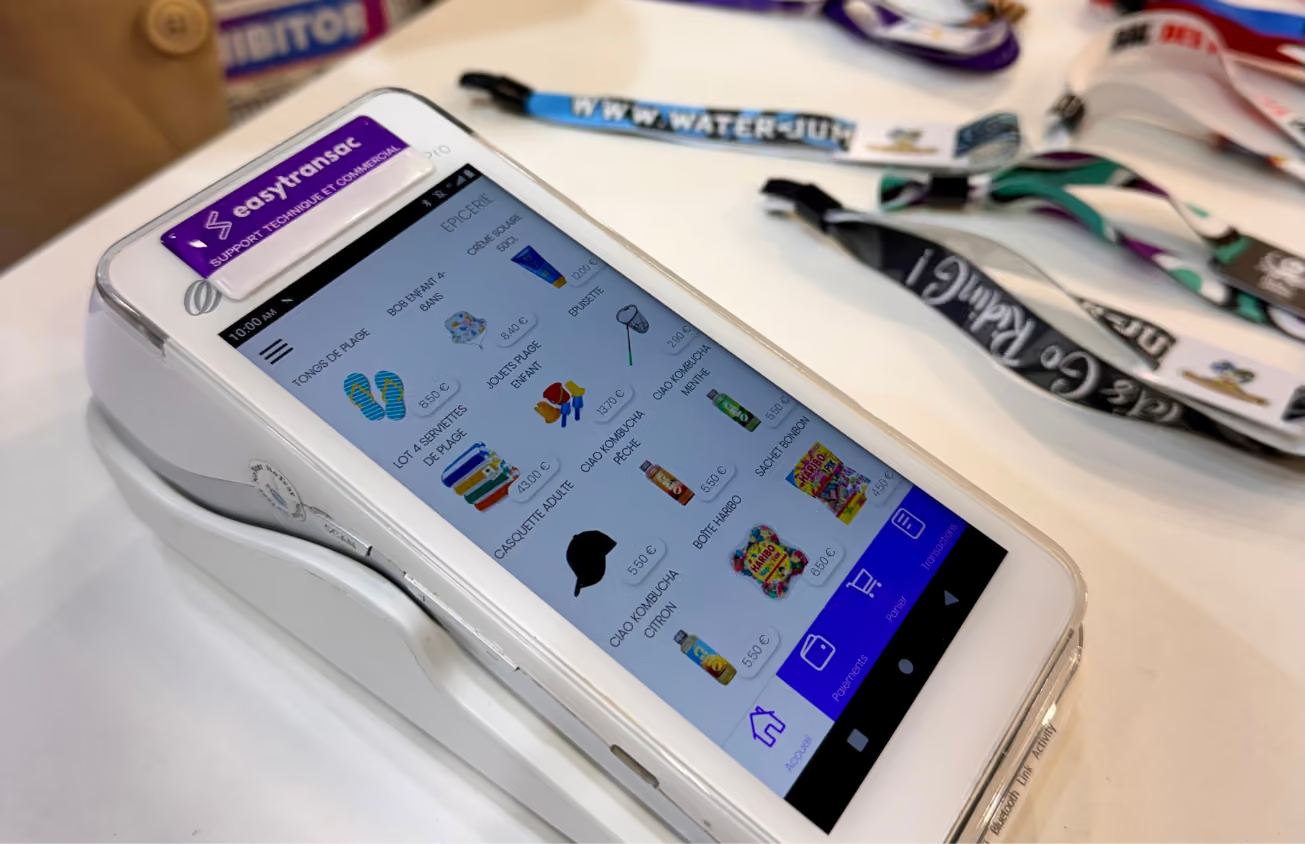
- A single tool for security deposits, stays, extras, and the campground store or snack bar—with EasyPOS and its integrated product catalog
- Remote deposit via a payment link sent by email or text message before the customer's arrival, in addition to the card terminal
Do you run a campground, a hotel, or a rental business? Talk to an Easytransac expert to set up deposit processing on your payment terminal.
Easytransac, your trusted partner
As specialists in electronic payment solutions, we support restaurant owners, retailers, and event organizers with:
▸ High-performance VSEs(fixed or mobileAndroid terminals )
▸ An integrated checkout system for unified management
▸ Cashless to digitize cash on site
▸ An access control, accreditation and CRM system
FAQ on Security Deposits for Small Businesses
How long does a bank transaction record remain on a point-of-sale terminal?
Under the PLBS system, merchants have 30 calendar days from the date of the initial authorization to process or cancel the transaction. It is recommended that merchants cancel the authorization as soon as the service is completed, without waiting until the deadline.
Is the bank transaction debited from the customer's account?
No. The amount is reserved on the card and temporarily reduces the available credit limit, but it is not debited. Only the charges that are actually collected at the end of the billing cycle are deducted.
Can we keep only part of the security deposit?
Yes. The merchant collects the amount of the actual expenses incurred, up to the limit authorized at the time the transaction was opened. On the Easytransac POS terminal, simply enter this amount when closing the transaction.
Does the customer need to be present to release the security deposit?
No. The transaction is processed using the transaction number printed on the receipt, without the customer's card.
Do all credit cards accept card imprints?
No. Some cards that require systematic authorization may decline the pre-authorization. Include a backup plan in your Terms and Conditions, such as a check or a deposit.
How much should I ask for as a security deposit?
The amount is set at the merchant’s discretion in its terms of sale, based on the risk covered. At campgrounds, the amount is often between €150 and €400 per rental unit.
Can a security deposit be collected remotely, before the customer arrives?
Yes. With Easytransac, you send a payment link via email or text message: the customer registers their card details before arrival. The deposit is then in place at check-in, and the transaction is processed just as it would be for a card swiped through a point-of-sale terminal.